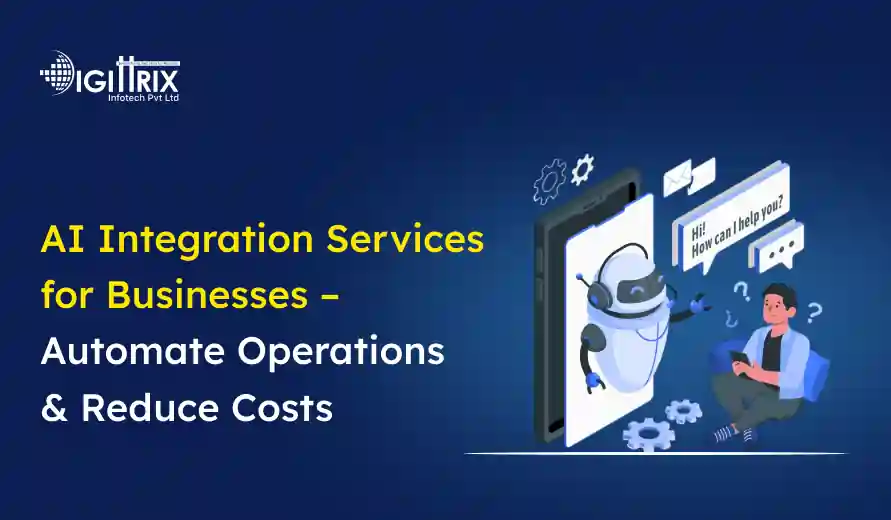
AI integration helps businesses automate workflows, reduce operational costs, and improve efficiency across departments through intelligent AI solutions.
Highlights

Co-Founder
Harsh Abrol 
4 min read
With Over 14 years of Experience in the IT Field, Helping Companies Optimise there Products for more Conversions
Modern businesses operate in a data-driven environment where speed, accuracy, and cost control directly affect profitability. Manual processes, repetitive administrative tasks, and disconnected software systems often slow operations and increase expenses. This is where AI integration services play a major role. Companies across industries are adopting intelligent systems to automate workflows, reduce operational costs, and improve decision-making.
From customer support automation to predictive analytics and smart data processing, artificial intelligence is no longer limited to large tech firms. Today, startups, mid-sized companies, and global enterprises are investing in structured AI adoption strategies to stay competitive.
In this detailed guide, we will explain what AI integration entails, how it works, its benefits, the implementation process, the pricing structure, industry use cases, and how businesses can select the right technology partner.
Stay ahead of competitors with AI-powered automation! Discover why smart businesses are adopting AI chatbots now.
AI integration services involve embedding artificial intelligence capabilities into existing business systems, software platforms, and operational workflows. Rather than building entirely new systems, AI tools are connected to current infrastructure, including CRM platforms, ERP systems, HR software, supply chain tools, and customer support applications.
The goal is simple: automate repetitive tasks, analyze large datasets quickly, and improve operational efficiency without replacing your entire technology ecosystem.
Examples include:
AI integration focuses on practical business outcomes rather than experimental technology.
Right now, you mostly talk about features and benefits. You can include a dedicated H2 on the types of AI services businesses can adopt.
Subsections could include:
This provides practical clarity and uses your secondary keywords naturally.
Organizations are under constant pressure to reduce operational expenses while maintaining service quality. Traditional automation handles rule-based tasks, but AI goes further by learning from patterns and improving over time.
Key reasons businesses are adopting AI:
AI systems can operate 24/7 without interruption, increasing productivity and speeding up processes.
AI integration typically includes multiple technical components that work together.
AI systems depend on data quality. Before integration begins, companies must:
Without structured data, AI performance remains limited.
AI solutions are not one-size-fits-all. Businesses may require:
Models are customized based on industry requirements and business goals.
AI tools are connected to existing systems using APIs. This ensures:
Integration must be secure and scalable.
AI is applied to automate specific workflows, such as:
AI systems require ongoing monitoring to ensure accuracy and performance. Models are updated periodically to reflect new data trends.
While these terms are related, there is a slight difference.
AI implementation services typically involve building or deploying AI models within a system. This includes training machine learning algorithms and configuring the technical infrastructure.
On the other hand, ai integration services focus on embedding AI into existing business operations and ensuring it works smoothly with current tools and processes.
Both services often work together during enterprise AI projects.
AI implementation services go beyond simple software deployment. They involve analyzing your business processes to identify opportunities for intelligent automation. Professionals in this field design AI models tailored to your business, train them using historical data, and test them under real-world conditions. For instance, a retail company might implement AI to forecast seasonal demand, while a finance firm may use AI to detect anomalies in transactions. The key to successful AI integration lies in combining these implementation services with strategic system integration, ensuring that AI works seamlessly with your current software infrastructure.
An experienced AI automation company provides technical expertise and strategic planning. Their responsibilities include:
Instead of randomly adding AI tools, structured automation ensures measurable outcomes.
 Planning to Integrate AI into Your Business Systems?
AI integration can automate workflows, reduce operational costs, improve decision-making, and enhance customer experiences. Whether you need predictive analytics, intelligent automation, or AI-powered CRM and ERP integration, a scalable and secure solution is essential for long-term growth.
Looking to integrate AI into your business? Talk to Digittrix experts today.
Start AI Integration →Before integrating AI, businesses often seek artificial intelligence consulting to evaluate feasibility and return on investment.
Consultants help companies:
Consulting reduces risk and prevents unnecessary technology investments.
Include a clear list of steps a business should follow before hiring an AI automation company or an AI consulting service.
Points to cover:
Many enterprises have successfully leveraged business automation using ai to improve efficiency:
Retail: An eCommerce company integrated AI chatbots with its CRM, reducing response time for customer queries by 60% and improving sales conversion.
Healthcare: Clinics implemented AI-powered scheduling systems, which minimized appointment overlaps and reduced administrative workload by 40%.
Manufacturing: Production units adopted predictive maintenance AI, detecting equipment issues before failures occurred, saving thousands in downtime costs.
Finance: Banks implemented AI models to automatically flag suspicious transactions, increasing fraud detection rates by 70%.
These examples highlight the tangible benefits of intelligent automation across industries.
Large-scale enterprises use ai solutions for enterprises across multiple sectors:
Enterprises gain not only efficiency but also strategic insights, helping them stay ahead of competitors in a rapidly evolving business landscape.
A structured process ensures successful deployment.
Identify operational challenges and automation opportunities. This involves interviewing key stakeholders, mapping workflows, and identifying where AI can reduce bottlenecks or repetitive tasks.
Evaluate data availability, infrastructure capacity, and expected ROI. It also includes assessing technical constraints, estimating costs, and prioritizing AI use cases that deliver the greatest impact.
Define the system architecture, integration points, and required AI models. During this stage, workflow diagrams and prototypes are developed to ensure alignment with business objectives.
Build or customize AI models to meet business needs. Developers refine algorithms and define rules that align with the company’s data patterns and industry-specific requirements.
Connect AI modules to existing software platforms. This step ensures seamless communication between AI tools and current systems, such as CRM, ERP, or HR platforms, without disrupting ongoing operations.
Conduct performance, security, and accuracy testing. Comprehensive testing identifies errors, verifies model predictions, and ensures compliance with company standards and data privacy regulations.
Launch AI-powered workflows in a production environment. Deployment is often done in phases to reduce risk, starting with critical operations and gradually expanding to other departments.
Track performance metrics and refine models over time. Ongoing evaluation enables the AI to learn from new data, improve predictions, and adapt to evolving business requirements.
Pricing depends on complexity, data volume, and infrastructure requirements.
Costs vary depending on customization and long-term support contracts.
Businesses should track measurable outcomes such as:
Clear metrics justify investment.
Clear project planning helps control costs.
Despite its advantages, AI adoption comes with challenges:
Proper planning and consulting reduce these risks.
 Integrate Advanced AI Solutions for Your Business
Implementing AI integration requires more than basic automation tools. Predictive analytics, intelligent workflow automation, secure data processing, and seamless integration with existing CRM, ERP, and business systems are essential. Digittrix helps businesses integrate AI solutions that improve efficiency, reduce costs, and enhance decision-making.
Looking to integrate AI into your business? Talk to Digittrix experts today.
Businesses should track measurable outcomes such as:
Clear metrics justify investment.
AI is widely used in:
Each industry benefits from automation and predictive intelligence.
AI continues improving as it processes more data.
Selecting the right AI automation company is critical to achieving ROI. Companies should evaluate:
Industry Expertise: Ensure the company understands your sector and regulatory requirements.
Technical Capabilities: The provider should have experience with machine learning, NLP, computer vision, and predictive analytics.
Integration Experience: Seamless integration with your current systems reduces operational disruption.
Scalability: The company should design solutions that grow with your business.
Support & Training: Post-deployment support and staff training ensure smooth adoption.
By choosing the right partner, businesses can avoid costly errors and maximize the efficiency of AI systems.
AI adoption is increasing globally. Cloud computing, edge computing, and advanced machine learning models are making AI more accessible to businesses of all sizes.
Companies that integrate AI early gain operational efficiency and cost advantages. As data volumes increase, intelligent automation will become a standard requirement rather than a competitive advantage.
Want to build smarter astrology apps with AI? Explore Digittrix’s AI astrology insights to personalize predictions and boost user engagement.
AI integration services are no longer optional for businesses aiming to automate operations and reduce costs. By embedding artificial intelligence into existing systems, companies can improve productivity, minimize manual tasks, and make data-driven decisions faster.
Whether through ai implementation services, hiring an ai automation company, seeking artificial intelligence consulting services, or adopting enterprise-grade automation strategies, AI adoption must be planned carefully.
With proper execution, AI becomes a long-term operational asset that supports scalable growth and cost optimization across departments.
Artificial intelligence is no longer just a futuristic concept—it is a practical tool for automating business operations and reducing costs. By integrating AI into existing systems, companies can manage repetitive tasks, analyze large datasets, forecast trends, and make informed decisions faster and more accurately. From improving customer support to streamlining supply chains and optimizing financial processes, AI enables measurable improvements across all departments.
At Digittrix, we specialize in AI integration services tailored to your business needs. Our team works closely with you to identify automation opportunities, implement AI models, and integrate intelligent systems with your current software platforms. Whether you need predictive analytics, workflow automation, enterprise-grade AI solutions, or seamless integration with CRM and ERP systems, we help you achieve operational efficiency without disrupting existing processes.
Take the next step to optimize your business operations. Connect with Digittrix to explore practical AI solutions that save time, reduce costs, and improve performance. Call +91 8727000867 or email us at digittrix@gmail.com to start planning your AI integration strategy today.

Do you need help in Web Development ?


Join over 1500+ businesses we've already helped!
AI integration services involve adding artificial intelligence capabilities to your existing business systems and workflows. These services help automate repetitive tasks, process large volumes of data quickly, and improve overall operational efficiency.
AI systems automate routine work, reduce human errors, and accelerate decision-making. This minimizes labor costs, improves resource allocation, and lowers operational expenses across departments.
AI implementation services focus on building or deploying AI models and infrastructure. AI integration services, on the other hand, focus on embedding AI into your current systems and processes so it works seamlessly with existing tools.
Industries such as healthcare, finance, retail, manufacturing, logistics, education, and IT services benefit from AI integration. Common applications include predictive analytics, automated customer support, inventory management, fraud detection, and employee performance monitoring.
Look for a company with proven experience in AI projects, strong technical skills, knowledge of your industry, secure data-handling practices, and positive client feedback. Also, ensure they provide post-deployment support and a clear project plan with costs and timelines.

Enhance efficiency with creative business solutions that drive productivity and revenue. Contact us for tailored solutions designed specifically for your business
Make the right business move.
Your email ID is Confidential.






©2026Digittrix Infotech Private Limited , All rights reserved.
 +91-8727000867
 +64 22
003 5555
+64 22
003 5555


 0172-4655268
 Request Instant Call
 Hire Remotely