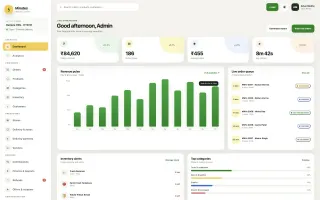
Test the customer workflow
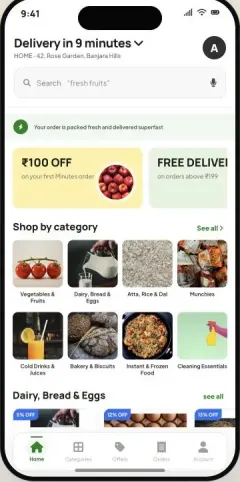
Browse sample products and inspect search, variations, cart, coupon, address, payment, order-tracking, rating, and account screens.
Open customer demoSelected organizations represented across Digittrix's broader product portfolio. These are cross-industry references, not grocery client case studies.
Grocery delivery app development connects online ordering with store and last-mile operations. Digittrix provides on-demand grocery delivery app development and online grocery app development for single-store, multi-store, and marketplace models. A typical platform combines a customer app or website, store or picker tools, a delivery partner app, an admin dashboard, and APIs for payments, maps, inventory, notifications, or an existing POS. The right model depends on store ownership, fulfillment, delivery responsibility, service area, and real-time stock accuracy. Digittrix supports this work through its mobile app development services; final cost and timing are confirmed after requirements and integration discovery.
We plan grocery ordering and operations software around these common bottlenecks. The project scope should define the workflow to change and the conditions used to test it.
Manual order and inventory management
Lack of real-time delivery tracking
Inefficient delivery route planning
Poor customer ordering experience
Payment gateway failures
Multi-store management issues
Limited scalability for growing demand
Inspect customer and operations prototypes, a product walkthrough, and a third-party-hosted portfolio record. Each item states what it demonstrates and its verification boundary.
Browse sample products and inspect search, variations, cart, coupon, address, payment, order-tracking, rating, and account screens.
Open customer demoExplore simulated order, catalog, inventory, store, zone, driver, vendor, commission, finance, refund, coupon, and staff controls.
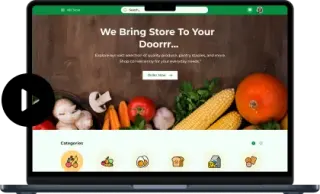
Open operations demoUse the demo hub to view the recorded walkthrough and the customer-interface screen gallery, with the evidence boundary stated clearly.
View video and galleryFreelancer hosts this grocery app portfolio item under the Digittrix profile and identifies Digittrix as its author. The record includes grocery product scope, technology tags, and a link to the public walkthrough. It does not identify a client or verify production outcomes.
Verification boundary: Freelancer verifies that the portfolio publication is publicly attributed to the Digittrix profile. It does not identify the client, confirm an app-store launch, or validate business-performance claims.
Evidence boundary: all names, orders, prices, delivery times, charts, and performance figures inside the first-party prototypes are illustrative sample data. The demos do not place live orders, process payments, or claim client outcomes. The Freelancer link is a third-party-hosted portfolio record, not a named-client case study.
Review the complete screenshot-led grocery platform product demonstration case study
Grocery delivery app development is the process of designing and building mobile or
web products that let customers order groceries for delivery or pickup while giving operations teams
tools to fulfill those orders. Grocery shopping app development covers the customer-facing browsing,
cart, checkout, and account journey, while the wider delivery platform connects fulfillment and
administration.
The scope can include product browsing, cart management, payment-gateway integration, order-status
updates, and delivery scheduling. Optional recommendations, route planning, and inventory updates
depend on suitable data, consent, operating rules, and compatible vendor APIs.
Branded ordering apps for individual supermarkets, local grocers, and specialty stores.
Platforms that connect customers with multiple grocery stores through one ordering experience.
Location-based catalogs, branch inventory, order routing, and centralized controls for retail chains.
Grocery ordering app development usually connects several operational roles in one delivery platform. The final combination depends on whether the business is single-store, multi-store, marketplace-based, or uses dedicated picking and delivery teams.
Lets shoppers search and filter products, select variants or weights, manage a cart, choose an address and delivery slot, pay, track orders, receive notifications, contact support, and use a scoped SOS workflow in the mobile app.
Supports catalog, pricing, stock, incoming orders, picking, packing, substitutions, promotions, and store-level reporting for one location or multiple marketplace vendors.
Organizes pick lists, quantity or barcode checks, replacement approvals, packing, and dispatch readiness where fulfillment is handled separately from store administration.
Provides delivery assignments, navigation, customer contact, order-status updates, proof of delivery, issue reporting, and a role-based SOS workflow for in-house or integrated delivery teams.
Centralizes customers, stores, service zones, orders, payments, refunds, fees, promotions, permissions, and reporting so the platform can be managed from one place.
Our grocery delivery app development services cater to multiple business models in the retail and eCommerce ecosystem. For each model, the scope can define the relevant user roles, ordering flows, operational controls, and integrations. Supermarket app development commonly adds branch inventory, location-based catalogs, centralized reporting, and order routing.
Potential scope: inventory updates, multi-store operations, and bulk-order workflows.
Simple mobile apps with order management and local delivery features.
Subscription delivery systems and farm-to-home logistics solutions.
Potential scope: on-demand dispatch, status tracking, and route-planning integrations.
Bulk pricing, minimum order quantities, and CRM integration.
The right product scope depends on who owns the inventory, how many stores participate, and who handles fulfillment. This comparison gives stakeholders a practical starting point before features and integrations are estimated.
| Business model | Best suited to | Typical core scope |
|---|---|---|
| Single-store app | Independent grocers and specialty retailers | Branded catalog, inventory, pickup or delivery slots, payments, and store administration |
| Multi-store chain | One retailer operating several branches | Location-based catalogs, branch inventory, order routing, and centralized reporting |
| Multi-vendor marketplace | Platforms that onboard independent stores | Vendor onboarding, separate catalogs, commissions, order allocation, and marketplace controls |
| Hyperlocal or quick commerce | Businesses fulfilling within defined service zones | Live availability, zone rules, store or hub assignment, dispatch, and real-time tracking |
| B2B wholesale ordering | Wholesalers and business buyers | Account pricing, minimum quantities, approval flows, invoices, and repeat ordering |
Rapid-delivery models usually need tighter inventory accuracy, smaller service zones, store or hub assignment rules, dispatch controls, and clear handling for unavailable products.
The useful comparison is the operating model, not a feature-for-feature copy. A product plan should match your inventory ownership, fulfillment capacity, service areas, and customer delivery promise before the build scope is estimated.
For rapid local delivery, planning usually focuses on accurate live availability, small service zones, store or hub assignment, fast picking and dispatch, rider workflows, and clear handling for substitutions or unavailable items.
For broader grocery ordering, planning can include a deeper catalog, delivery slots, scheduled fulfillment, store or warehouse inventory, substitutions, repeat orders, and POS or ERP connections where compatible APIs are available.
A single store or defined zone can validate ordering, picking, and delivery before adding multi-store routing, marketplaces, dark stores, or city-by-city expansion. The delivery promise should be based on your actual operations, not copied from another brand.
Brand disclosure: Blinkit, Zepto, and BigBasket are independent brands. Digittrix is not affiliated with, endorsed by, or claiming to have built for them; their names are used only to explain commonly requested grocery operating models.
Prioritizing features by operational need helps avoid an overloaded first release. Start with the ordering and fulfillment path, then add growth and automation capabilities as the business gathers reliable data.
Advanced features depend on data quality, API availability, order volume, and the selected business model. They should be prioritized only after the required ordering and fulfillment workflow is clear.
Grocery platforms can connect with third-party payment, inventory, logistics, messaging, mapping, CRM, and ERP systems where compatible APIs are available. The integration scope should define data ownership, synchronization frequency, error handling, and operational fallbacks. Integration options include:
Quick answer: Digittrix offers a defined grocery delivery package at ₹75,000 with typical delivery in three weeks, multi-store grocery apps from ₹1.5 lakh with typical delivery in six to eight weeks, and marketplace or quick-commerce platforms from ₹2.5 lakh. The signed proposal confirms the final scope, timeline, and price.
₹75,000
Best for: Grocery businesses whose requirements fit the demonstrated package baseline and its written customization boundary.
Included baseline: Payment-gateway integration, maps, SMS, WhatsApp, white-label branding, agreed source-code access, app-store publishing from Digittrix accounts, six months of post-launch technical support, and three months of post-launch SEO, GEO, and AEO support.
Separate or excluded: GST, hosting, requirements outside the package baseline, and advertising media spend unless the written proposal includes them.
View the ₹75,000 packageFrom ₹1.5 lakh
Best for: Retail chains and multi-store operators that need connected ordering, store operations, delivery, and administration workflows.
Included baseline: Payment-gateway integration, maps, SMS, WhatsApp, app-store publishing from Digittrix accounts, six months of post-launch technical support, and three months of post-launch SEO, GEO, and AEO support within the written scope.
Separate or excluded: GST, hosting, third-party charges outside the agreed integrations, data migration, and requirements outside the written scope.
Request a written estimateFrom ₹2.5 lakh
Best for: Marketplace and quick-commerce operators that need multi-vendor, fulfilment, operational, and scale planning beyond a standard store app.
Included baseline: Payment-gateway integration, maps, SMS, WhatsApp, app-store publishing from Digittrix accounts, six months of post-launch technical support, and three months of post-launch SEO, GEO, and AEO support within the written scope.
Separate or excluded: GST, hosting, vendor onboarding operations, third-party charges outside the agreed integrations, and requirements outside the written scope.
Request a written estimatePricing reviewed . ₹75,000 is the defined package price; ₹1.5 lakh and ₹2.5 lakh are starting planning prices, not market averages or universal quotes. GST and hosting are separate. The signed proposal controls scope, schedule, payment terms, integration boundary, taxes, hosting, third-party charges, and exclusions.
A useful estimate requires a confirmed scope. Two grocery platforms can look similar to shoppers but require very different operational workflows, integrations, data migration, and QA effort.
An estimate is prepared after the operating model, product surfaces, and external dependencies are understood. Customer, store or picker, driver, admin, and web workstreams are estimated separately, followed by integrations, migration, testing, release preparation, and project management. The result is a planning range with documented assumptions, not a fixed quote.
Operating model, roles, platforms, store or vendor count, catalog and stock rules, service areas, languages, integrations, migration, traffic, security, and support expectations.
Discovery, UX, customer applications, operations tools, backend and APIs, integrations, QA and security testing, release preparation, documentation, and handover.
Only written-scope items are included. Cloud usage, transaction charges, paid APIs, store accounts, catalog preparation, taxes, and subscriptions are excluded unless explicitly included.
We re-estimate when scope changes, an API is restricted, source data needs more cleanup, a new market or requirement is added, or an external approval affects the launch plan.
These references inform discovery questions, technical requirements, and acceptance criteria. Their inclusion does not claim that every project is certified against every standard; applicability is agreed for each project.
Evidence boundary: standards describe targets and risk areas; they do not prove a certification, client outcome, delivery time, or performance result. Vendor-specific behavior is confirmed against the selected vendor’s current documentation during discovery.
A grocery app project typically moves through five connected stages. The final deliverables, dependencies, responsibilities, and acceptance criteria should be recorded in the written project scope before development begins.
Define inventory ownership, stores, service zones, fulfillment roles, revenue model, and launch priorities.
Map ordering, substitution, picking, delivery, refund, and administration journeys before visual design.
Plan application roles, data structure, environments, security controls, and third-party API dependencies.
Build agreed modules and validate ordering, payments, inventory, fulfillment, devices, and failure scenarios.
Prepare releases and handover, then plan monitoring, issue resolution, and improvements where included in the agreed support scope.
Technology
These are implementation options, not a prescribed stack for every project. Selection should fit the required platforms, integrations, expected traffic, security needs, team capabilities, and long-term maintenance plan.
React
Flutter
Swift
Kotlin
Node.js
PHP
Laravel
Python
CodeIgniter
MySQL
MongoDB
PostgreSQL
Firebase
MariaDB
Microsoft Azure
Docker
Google Cloud
Vercel
Netlify
Stripe
Razorpay
PayPal
Cashfree
Digittrix plans and develops grocery delivery applications around the agreed business model, user roles, integrations, and launch requirements. Its grocery app development services cover grocery mobile app development, responsive web ordering, backend, admin, release, and post-launch support within the written scope.
The written proposal should define milestones, responsibilities, integrations, acceptance criteria, ownership, third-party costs, release accounts, and post-launch support.
Before approving a project, ask for written confirmation of the full scope, commercial assumptions, ownership, and post-launch responsibilities.
Confirm included user roles, platforms, features, integrations, data migration, and anything specifically excluded from the estimate.
Record deliverables, review points, responsibilities, dependencies, test coverage, and the acceptance criteria for each stage.
Clarify project pricing, payment stages, hosting, subscriptions, transaction fees, and ownership of app-store, map, payment, and messaging accounts.
Define code, intellectual-property, documentation, data, infrastructure, warranty, support, response expectations, and the enhancement process.
Businesses often use different search terms for the same underlying product decision. This guide maps every term in the supplied keyword research to the scope it normally signals, so the wording leads to a useful planning answer instead of repeated sales copy.
Use these practical guides to compare scope, integrations, and release priorities before requesting an estimate.
Plan a grocery delivery app around your catalog, ordering, payment, fulfillment, and last-mile operations.
Whether you're a startup, local store, or enterprise, our team can help define a grocery delivery solution tailored to your business needs.
Planning in Chandigarh Tricity? Meet our grocery app development team in Mohali at the Sector 75 office by appointment.
Get clear answers to common questions about our grocery delivery app development services, process, and support.