 +91-8727000867
 +64 22 003 5555


PoC, Prototype, and MVP help businesses test ideas, refine designs, and validate market demand before large-scale manufacturing, reducing risks and optimizing product development costs.
Highlights
- Automation: reduce repeated data entry, reminders, approvals, sales follow-ups, invoice alerts, and support routing.
- Shared data: connect customers, quotes, orders, inventory, invoices, support tickets, and reports in one workflow.
- Cost control: track manual hours saved, fewer errors, faster reporting, inventory accuracy, and support resolution after launch.

Co-Founder
Harsh Abrol 
Since 2014, Digittrix has helped companies optimise digital products for stronger conversions.
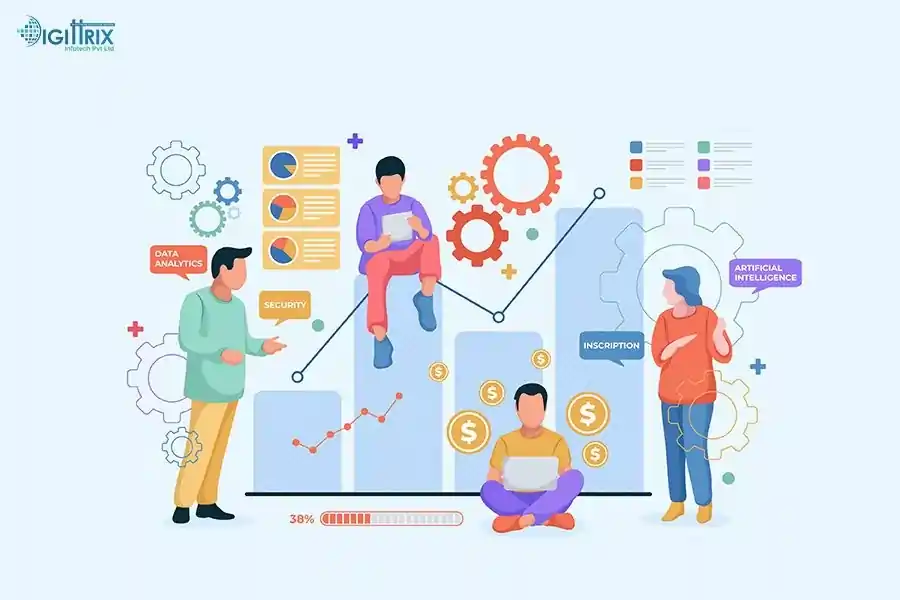
In today's fast-paced and highly competitive business landscape, finding ways to streamline operations, enhance efficiency, and save money is crucial. Customer Relationship Management (CRM) and Enterprise Resource Planning (ERP) software have emerged as powerful tools that can help businesses achieve these objectives. In this blog post, we will explore what CRM and ERP are and how implementing such software can lead to cost savings for your business.
2026 CRM and ERP Cost-Saving Framework
CRM and ERP software saves money when it removes repeated work, connects customer and operations data, and gives teams faster visibility into sales, inventory, finance, fulfilment, and support. The biggest savings usually come from fewer manual tasks, fewer errors, faster reporting, better stock planning, and clearer ownership across departments.
Quick answer: CRM reduces sales and support waste, while ERP reduces operational waste. A connected CRM and ERP setup helps teams avoid duplicate entry, missed follow-ups, inventory mistakes, slow invoicing, and disconnected reporting.
Where CRM reduces cost
- Lead and sales workflows: fewer missed enquiries, faster follow-ups, cleaner pipeline reports, and better quote tracking.
- Customer support: shared customer history, service notes, ticket ownership, reminders, and escalation rules reduce repeated manual work.
- Marketing efficiency: segmentation, campaign tracking, and customer behaviour data help teams spend on better-fit leads.
Where ERP reduces cost
- Inventory and operations: stock visibility, purchase planning, order tracking, and fulfilment updates reduce waste and delays.
- Finance and approvals: invoice alerts, payment status, purchase approvals, and reporting dashboards reduce manual reconciliation.
- Management visibility: dashboards help leaders see revenue, costs, stock, tasks, support load, and process delays sooner.
KPIs to prove savings after implementation
- Manual data-entry hours saved, duplicate records reduced, and report preparation time reduced.
- Lead response time, follow-up completion, support resolution time, and quote turnaround time.
- Inventory accuracy, order cycle time, invoice cycle time, approval delays, and dashboard usage.
GEO and AI-search clarity
For stronger search and AI visibility, this topic should clearly explain CRM, ERP, CRM ERP integration, workflow automation, cost-saving areas, implementation KPIs, and related planning pages instead of relying on broad unsupported statistics.
For deeper implementation planning, compare our ERP and CRM development services, custom CRM vs ERP guide, AI-powered ERP CRM systems guide, and ERP CRM KPI guide.
What is CRM?
CRM stands for Customer Relationship Management. It is a software system designed to manage and optimize interactions with customers and potential customers throughout the customer lifecycle. CRM software enables businesses to store and organize customer data, track sales leads, manage marketing campaigns, and provide personalized customer service. It aims to enhance customer satisfaction, increase customer retention, and drive sales growth.
Struggling with manual tasks and scattered business data? Read how ERP and CRM systems improve productivity through data access and automation to simplify workflows and support faster decision-making.
What is ERP?
ERP stands for Enterprise Resource Planning. It is a comprehensive software solution that integrates various core business functions into a centralized system. ERP software typically encompasses areas such as finance, accounting, human resources, supply chain management, inventory management, and manufacturing processes. The goal of ERP is to facilitate efficient information flow and process automation across different departments, leading to improved productivity and better decision-making.
Difference between CRM and ERP
While both CRM and ERP software are crucial for business success, they serve different purposes and focus on different aspects of operations.
CRM primarily concentrates on managing customer relationships and optimizing sales and marketing processes. It helps businesses understand their customers better, nurture leads, track interactions, and deliver personalized experiences. CRM systems are typically used by sales teams, marketing departments, and customer support teams.
On the other hand, ERP software focuses on integrating and managing various internal business functions. It ensures seamless data flow and coordination between different departments, enabling efficient resource allocation, streamlined workflows, and improved operational efficiency. ERP systems are commonly utilized by finance, HR, procurement, and manufacturing teams.
Maximizing Growth Opportunities with CRM Software
CRM software works by tracking your current or potential customers' behavior and actions via your company's website, social media, or email marketing campaigns, and then guiding the customer through the sales or buying funnel by sending a triggered email or alerting a sales representative of the customer's interest.
Track Campaign Performance Before Cutting Costs
Marketing campaigns are an important part of any business as they help you reach out to your target audience and connect with them effectively. However, if these campaigns are not tracked properly then there is no way for you to know how well they worked or what went wrong with them so that you can improve upon them in the future. By using CRM strategy you can track each campaign step-by-step and monitor how they performed over time so that you can make improvements accordingly or stop those which didn’t work well enough for your needs.
 Planning to Reduce Costs with ERP & CRM?
Manual processes and disconnected systems can slow your business down. Digittrix builds ERP and CRM solutions that centralize data, automate workflows, and help you control operational expenses.
Improve efficiency & save costs →Reduce Customer Acquisition Waste
A customer relationship management (CRM) system helps you to track all your customer information and manage it more efficiently. This way, when it comes to acquiring new customers, you will be able to target those who are most interested in your product or services. You can also create more effective marketing campaigns so that you will spend less time and money on new customers and start making profits sooner than before.
Reduce Production and Inventory Waste
If you have a manufacturing or retail store, then production costs are one of your biggest expenses. ERP and CRM systems can help you reduce these costs by making it easier to manage orders and inventory levels efficiently. The data collected from each customer interaction helps businesses identify patterns so that they can predict future sales and trends accurately (based on past performance). This helps them plan production based on actual demand instead of speculation, thus avoiding overproduction and under-utilization of resources like raw materials, machinery, etc., which ultimately reduces production costs.
This also saves them significant amounts of money due to the lack of wastage during production phases and increased efficiency during the product shipping phase.
Use Customer Data to Lower Support Costs
Customer service cost reduction is one of the most obvious benefits of implementing a CRM strategy.
CRM and ERP software can lower support costs when teams have customer history, order status, ticket ownership, service notes, and follow-up tasks in one place. The goal is to reduce repeated questions, missed updates, manual lookup time, and avoidable escalations.
Automate Support Follow-Ups and Escalations
Customer support is an important part of your business. But it can also be very costly. The cost of providing customer support can range from a few hundred to thousands of dollars every month. CRM systems can help you reduce your costs by letting you automate some of the manual processes involved in customer support, like scheduling appointments, sending out reminders, and storing information about customers. With this information at hand, you can provide better support to them and increase customer satisfaction levels as well.
Increase Efficiency with CRM Software
Another way that CRM software can help reduce costs is by streamlining processes and improving efficiency throughout your organization — from marketing to sales to customer service and beyond. This not only reduces costs but also increases revenue by enabling you to do more with your existing resources.
 Planning ERP & CRM Implementation for Your Business?
Selecting the right ERP and CRM system goes beyond features. Data integration, workflow automation, scalability, and cost control are key to improving productivity. Digittrix helps businesses evaluate, design, and implement ERP and CRM solutions that support real operational efficiency.
Improve Productivity With CRM Software
When it comes to increasing productivity and efficiency within your organization, one of the most effective ways is to provide your employees with access to all of their data in real-time so they can make better decisions faster, which ultimately results in better customer experiences and higher revenue growth overall.
Automated Sales Processes
The best part about using a CRM system is that it automates the sales process. For instance, the software collects data from customers and creates a profile for them with their preferences and needs. Thus, you can easily tailor your products and services according to their needs rather than relying on random guesses for marketing campaigns or sales pitches.
Centralized Communication
With a CRM system installed on your computer or mobile phone, you never have to miss a call or message from any customer again! All communications are stored in one place so that you do not have to spend time searching for important things.
Drive Growth and Efficiency with ERP Software
When discussing CRM, we must not overlook the advantages of ERP solutions for your business. Cloud-based ERP software solutions are quickly becoming the go-to option for many businesses. Why? Because they offer so many benefits, including:
Real-time information, The cloud-based infrastructure of an ERP solution allows for real-time information to be available to all users at once.
Access business data from anywhere at any time. You can access your data anytime and anywhere using a web browser or mobile device.
Automatic Upgrades, Cloud-based ERP solutions automatically update when new versions are released, without requiring manual upgrades or updates. This saves on unnecessary expenses and helps ensure that your company is always running on the latest version of the software.
Reduce Manual Processes, Cloud-based ERP solutions automate manual processes such as order processing, inventory management, and sales order generation, which frees up valuable employees
Save on Unnecessary Expenses, Cloud-based ERP solutions enable companies to save money by eliminating capital expenditures (CAPEX) associated with purchasing hardware and software licenses and installing them internally within their organizations. These expenses can be prohibitively expensive and out of reach for many small businesses, but they're often not necessary with cloud-based solutions since they don't require expensive upfront investments in hardware or software licenses.
Implementing ERP-CRM? Learn key metrics to evaluate success and maximize efficiency.
Final Words
CRM and ERP solutions are all-in-one tools that can help in pushing your business to new limits. Moreover, a CRM and ERP system can streamline management and also help in reducing costs. Surprisingly, many firms still rely upon outdated methods like spreadsheets, which offer little insight and relief in work .
Develop Custom CRM and ERP Software to Match Your Workflows
We recognize that every business has its own unique challenges and objectives. That's why our approach to ERP and CRM development is tailored to meet your specific needs. We collaborate closely with you to fully understand your goals, delivering customized solutions that drive meaningful business results. If you want to develop your ERP and CRM solutions, contact Digittrix.
Whether you're aiming to automate operations, enhance customer interactions, or optimize data usage, our expert team is ready to assist. To discover how our ERP and CRM development services can help your business unlock its full potential, schedule your appointment or book your consultation today with our expert technical managers by calling +91 8727000867
or write to us for all your queries at hello@digittrix.com
 FAQ's
FAQ's