+91-8727000867
 +64 22 003 5555


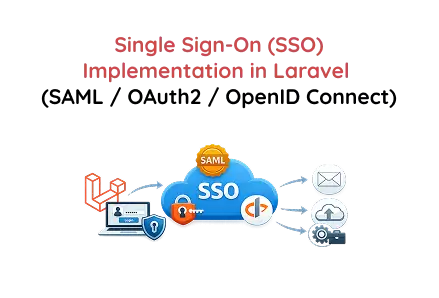
Organizations using SSO report up to 50% fewer password resets and stronger access security across enterprise SaaS and multi-application environments worldwide.
Key Points
- SSO reduces password reset requests by up to 50% in enterprises globally each year on avg.
- Over 70% of enterprises use SAML or OIDC for secure authentication in today's business systems.
- SSO improves login speed by 30% across integrated platforms and apps in large enterprises.
Tech Version – PHP 8+ | Laravel 9+
Single Sign-On (SSO) implementation in Laravel allows users to authenticate once and access multiple applications without repeatedly logging in. Instead of managing usernames and passwords within your Laravel application, authentication is handled by a trusted external Identity Provider (IdP) such as:
- Microsoft (Azure AD)
- Okta
- Auth0
Your Laravel application delegates authentication to these providers, verifies the response, and securely logs users in to the system.
For businesses offering Custom Web Development and enterprise-grade Website Development Services, integrating SSO is no longer optional; it is a competitive advantage.
Why Implement SSO in Laravel?
Modern SaaS platforms and enterprise applications require:
- Centralized authentication
- Enterprise security compliance
- Seamless user experience
- Reduced password-related vulnerabilities
- Faster onboarding for B2B clients
If you plan to hire Laravel developers for enterprise systems, SSO expertise should be a core requirement. Any professional web development company building scalable SaaS products must understand OAuth2, OpenID Connect, and SAML architecture.
SSO Protocols Overview
Laravel supports three major SSO standards:
SAML (Security Assertion Markup Language)
- XML-based authentication protocol
- Common in enterprise corporate environments
- Used with corporate Identity Providers
- Supports Single Logout (SLO)
SAML is typically implemented in large-scale enterprise custom web development projects where clients use corporate identity systems.
OAuth2
- Authorization framework
- Enables delegated access
- Common for social login integrations
- Widely adopted across SaaS platforms
OpenID Connect (OIDC)
- Authentication layer built on OAuth2
- Modern standard using JWT tokens
- Recommended for new applications
For modern website development services, OpenID Connect is the preferred approach because of its flexibility and security.
SSO Architecture Flow
User clicks "Login with SSO."
↓
Laravel redirects the user to the Identity Provider
↓
User logs in at Provider
↓
Provider sends an authentication response
↓
Laravel validates the response
↓
User is logged in (or created)
This architecture removes password handling from your Laravel application, a critical security improvement for enterprise Web Development Company projects.
OAuth2 / OpenID Connect Implementation (Recommended)
Most modern Laravel systems use OAuth2 or OpenID Connect.
Step 1: Install Laravel Socialite
Step 2: Configure config/services.php
Step 3: Add Environment Variables
Step 4: Create Authentication Routes
This flow works the same way for Microsoft Azure AD, Okta, and Auth0.
If you hire Laravel developers for enterprise SaaS development, they should understand how to implement secure callback handling and token validation.
SAML Implementation (Enterprise Use Case)
For large organizations that use corporate identity systems, SAML is often required.
Install SAML Package
Configuration Steps
- Obtain IdP metadata XML
- Configure Assertion Consumer Service (ACS) URL
- Configure Entity ID
- Validate SAML response signature
- Map SAML attributes to local user fields
Example Attribute Mapping
Enterprise-level Website Development Services must include rigorous signature validation to prevent identity spoofing.
User Provisioning Strategy
When users log in via SSO, define a clear provisioning model.
Option 1: Auto Create User
Automatically create the user if the email does not exist.
Option 2: Restrict to Pre-Registered Users
Allow only existing users in your database.
Option 3: Role Mapping
This is essential for multi-role SaaS platforms developed by a professional Web Development Company.
OpenID Connect Token Validation (Critical)
When using OIDC, validate:
- ID Token signature
- Issuer (iss)
- Audience (aud)
- Expiration (exp)
- Nonce
- State parameter
Never skip token validation in production. Secure implementation is a hallmark of expert Custom Web Development teams.
Logout Handling
Basic Logout
Auth::logout();
Single Logout (SAML Only)
- Send logout request to IdP
- Invalidate both sessions
This ensures enterprise-grade session management.
API Authentication with SSO
For SaaS platforms with APIs:
Use Laravel Sanctum or Passport.
Protect routes:
This is particularly important for mobile apps and SPA dashboards developed using modern Website Development Services.
Multi-Tenant SSO (SaaS Model)
If your SaaS supports multiple tenants:
- Configure a separate IdP per tenant
- Store SSO credentials per tenant
- Dynamically resolve configuration
Multi-tenant SSO is a common requirement when enterprises hire Laravel developers for scalable SaaS platforms.
Security Best Practices
To maintain enterprise-grade protection:
- Always use HTTPS
- Validate OAuth state
- Validate OIDC nonce
- Verify token signatures
- Restrict redirect URLs
- Log authentication attempts
- Rotate secrets periodically
- Prevent replay attacks
Any professional Web development company should strictly follow these practices.
Architecture Summary
| Component | Responsibility |
|---|---|
| Identity Provider | Handles authentication |
| Laravel Application | Validates & logs in the user |
| Socialite / SAML Package | Protocol integration |
| User Table | Stores provider ID |
| Session / Token | Maintains authentication |
Business Benefits of SSO
Without SSO
- Multiple passwords
- Poor user experience
- Security risks
- Harder enterprise onboarding
With SSO
- Centralized authentication
- Enterprise-ready integration
- Higher security compliance
- Faster user onboarding
- Better scalability
For companies offering Custom Web Development, implementing SSO significantly increases enterprise adoption and client trust.
Final Words
Implementing Single Sign-On (SSO) in Laravel using OAuth2, OpenID Connect, or SAML transforms your application into an enterprise-ready system. Whether building SaaS products, B2B dashboards, or corporate portals, SSO is a critical component of modern website development services.
If you plan to hire Laravel developers, ensure they have deep expertise in SSO architecture, token validation, and enterprise security standards. A reliable web development company with SSO expertise can help you build secure, scalable, and future-ready web platforms.
 Frontend
 Backend
 Deployment






 Request Instant Call
 Hire Remotely